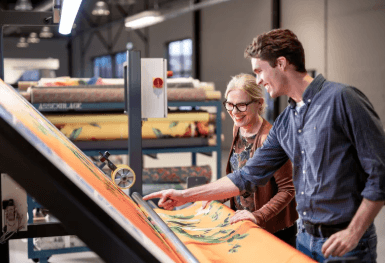
The Rise of Digital Fabric: How 3D Textile Tools Are Transforming Garment Visualization

The fashion and textile industry is currently undergoing its most significant shift since the Industrial Revolution. For decades, the process of creating a garment remained physical: sketch, sample, sew, repeat. However, the emergence of high-fidelity digital textiles has dismantled these traditional barriers, ushering in an era of “Digital Twin” technology that is as precise as the physical thread.
The Evolution from Sketch to Simulation
Historically, designers relied on 2D sketches and physical fabric swatches. While tactile, this method was prone to error and incredibly wasteful. If a fabric didn’t drape as expected during a photoshoot or a runway fitting, the entire sample was discarded.
Today, 3D textile tools have bridged the gap between imagination and reality. By digitizing the physical properties of a fabric—its weight, elasticity, friction, and thickness—designers can now visualize how a garment will behave in motion without ever touching a pair of scissors. This transition is not just about aesthetics; it is about the mathematical precision of fabric behavior.
Understanding the Power of Digital Textiles
The term digital textiles refers to more than just a high-resolution image of a pattern. In the context of modern 3D visualization, it represents a data-rich asset that carries all the physical characteristics of its real-world counterpart.
1. Physics-Based Drape and Movement
Traditional CGI often looked “stiff.” Modern 3D textile tools use physics engines to simulate how a silk chiffon flows versus how a heavy denim resists movement. This allows brands to see “stress maps” on a digital avatar, identifying where a garment might be too tight or where the fabric might pucker.
2. Texture and Lighting Realism
Advanced rendering techniques like PBR (Physically Based Rendering) allow designers to see how light interacts with different weaves. Whether it’s the subtle sheen of satin or the matte, porous texture of linen, the visual fidelity is now so high that it is often indistinguishable from a photograph.
Impact on the Supply Chain: Speed and Sustainability
The fashion industry is frequently criticized for its environmental footprint. The rise of digital fabric tools offers a powerful solution to some of its most pressing sustainability challenges.
Reducing Physical Waste
In a traditional workflow, dozens of physical samples are shipped across continents before a final design is approved. By utilizing digital fabric twins, companies can reduce physical sampling by up to 70-80%. This means less fabric waste, fewer chemicals used in dyeing prototypes, and a massive reduction in the carbon footprint associated with shipping samples.
Accelerating “Time-to-Market”
What used to take months can now be done in weeks. Digital assets can be shared instantly between designers in Paris and manufacturers in South Asia. Changes to a print or a fabric weight can be made with a few clicks, allowing brands to respond to fast-changing consumer trends with unprecedented agility.
The Role of 3D Textile Tools in E-commerce
The transformation doesn’t stop at the manufacturing stage; it extends all the way to the end consumer. Digital fabrics are changing how we shop online.
- Virtual Try-Ons: Consumers can now see how a dress fits their specific body shape, reducing the high rate of returns that plagues e-commerce.
- Customization: Brands can offer “made-to-order” services where customers choose the fabric and color digitally before the item is even produced.
- Marketing Content: High-quality digital renders are being used for lookbooks and social media campaigns long before the physical inventory arrives at the warehouse.
The Technical Backbone: Digitizing the Tactile
How do you turn a piece of physical cloth into a digital asset? The process typically involves:
- Scanning: High-resolution scanners capture the visual texture and weave pattern.
- Testing: Specialized machines measure the “bending” and “stretching” properties of the fabric.
- Integration: This data is fed into 3D software where the digital textile becomes a dynamic material ready for garment construction.
This level of detail ensures that when a designer chooses a specific knit in the software, they know exactly how it will look and feel when it finally rolls off the production line.
Overcoming Challenges in Digital Adoption
While the benefits are clear, the transition to a fully digital workflow isn’t without hurdles. There is a learning curve for traditional pattern makers and designers who are used to the “touch and feel” of fabric. Furthermore, the initial investment in high-end scanning and 3D simulation software can be significant for smaller labels.
However, as the technology becomes more accessible and the demand for sustainable practices grows, the shift is becoming mandatory rather than optional. The industry is moving toward a future where every physical fabric will have a mandatory digital counterpart.
The Future: AI and the Meta-Closet
Looking ahead, the integration of Artificial Intelligence (AI) with 3D textile tools will further refine visualization. AI can predict fabric trends or even suggest the best textile choice for a specific garment silhouette based on historical data.
Moreover, as we move toward digital-first spaces like the Metaverse or high-fidelity gaming, these digital textiles provide the wardrobe for our digital identities. The same asset used to manufacture a physical jacket can be sold as a digital wearable, opening up entirely new revenue streams for designers.
See also: How Custody Decisions Impact Family Life Long-Term
Conclusion
The rise of digital fabric tools is more than a technological trend; it is a fundamental reimagining of the fashion lifecycle. By prioritizing visualization and simulation, the industry is becoming smarter, faster, and significantly more sustainable.
As 3D tools continue to evolve, the line between the physical and the digital will continue to blur. For designers, manufacturers, and consumers alike, the result is a more efficient and creative world where the only limit to fashion is imagination—not the constraints of physical prototyping. The era of the digital loom has arrived, and it is weaving a more sustainable future for the world of style.